Like a photograph in a war, America’s Point-In-Time counting system for assessing our homeless population is merely a snapshot, missing somewhere around two-thirds of what’s really going on. Unfortunately, it seems to be the most commonly used statistic for, perhaps, all the wrong reasons.
The PIT counts are necessary to keep the government (HUD) informed on the number of homeless people taking advantage of some form of shelter or housing, and it gathers this information from all CoC (Continuum of Care) programs around the country. The problem is that the PIT count only represents about ten days out of the year, and it only counts the people who are receiving some form of shelter. It does not count the people who are not in those programs during the rest of the year, nor the people who are not in those programs at all.
A better count is the HMIS total annual unique encounters. Though this number also cannot count people who do not take advantage of the service providers which report their numbers, but in some cases, the HMIS number is 350% higher than the PIT count. This means the national PIT count from January of 2025, which was 776,000, is likely less than a third of the actual population. Hmm… time to start digging.
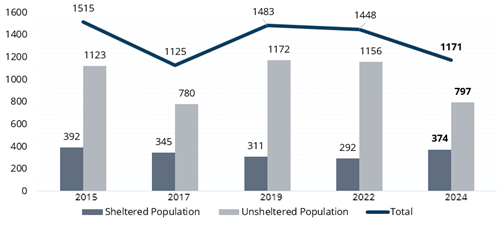
| PIT count from San Luis Obispo. |
| Yup, Just as I suspected, there are a few sources citing homelessness estimates well in excess off three million people per year in America. It’s worse than I thought. I can’t really blame the count stats, though. I mean, how would you count the number of homeless people? At best, there will still be a degree of estimation involved. |
| The bad news is that the actual number of homeless people is somewhere north of 3 million, and because of the impossibility of performing an accurate census, that number is a floor, not a ceiling. Here’s the good news: Because the people who are sheltered during the PIT count days in January are less likely to be current users of illicit drugs (in order to qualify for shelter programs), that means drug use isn’t nearly as horrible as when we include people who are not sheltered by organizations that demand sobriety for entrance. |